
INTRODUCTION
Suppose you’ve snapped a video on your phone, shared original photos online, painted a portrait, written a story, or designed a logo, you’ve already interacted with copyright law, and you may not have even known it. In that case, you’ve already interacted with copyright law, even if you didn’t know it. Copyright protects professional creators, as well as small, medium, and large businesses, and anyone who produces original work. But what does copyright law really mean, and why does it matter?
WHAT IS COPYRIGHT LAW?
Copyright is an area of intellectual property law that gives you the exclusive right to control how your work is used. In the United States, copyright attaches automatically when you create an original work of expression and fix it in a tangible form. This means you already have some automatic legal protections the moment you create something.
However, relying only on this automatic protection has huge limitations and can leave you vulnerable. Registering your copyright with the U.S. Copyright Office generally provides much stronger legal standing. Registration may allow you to bring a lawsuit for infringement, claim statutory damages, and recover attorney’s fees, all of which are not typically available through automatic copyright alone. Because registration can be complex and very time-sensitive, working with an attorney may help you avoid costly mistakes and protect your rights more effectively.
WHEN COPYRIGHT PROTECTS YOUR BUSINESS
Michael, a bakery owner, scales his marketing efforts by investing in professional design work for his brand. He creates a specialized bread logo and similar packaging designs, which he posts online to his audience. His rebrand goes viral, with customers sharing the new designs and placing orders online. A few months later, a new bakery opens up and uses Michael’s designs on their website and social media, misleading customers into thinking it’s his shop and placing orders with them instead.
If Michael had registered the copyright for his logo artwork and photos, he would have very strong proof of ownership and greater legal rights to stop the competitor from using them. With a lawyer’s help, he could send a cease-and-desist letter, seek damages for lost revenue and even statutory damages in the tens or hundreds of thousands, and protect his brand reputation. This stops the immediate problem and saves him from the high cost of rebranding and rebuilding customer trust later.
Beyond copyright, Michael could also strengthen his protection by registering a trademark for his bakery’s name or slogan. (Yes! You can copyright and trademark a logo). While copyright protects the original creative works, such as logos and photos, a trademark prevents competitors from using a confusingly similar name or logo in the marketplace.

WHAT DOES COPYRIGHT PROTECT?
Copyright law covers a wide variety of creative works, such as:
- Books, articles, and blog posts
- Paintings, digital illustrations, and photos
- Software, apps, website code, and game mods
- Social media posts, captions, and original memes
- Video game graphics and assets, soundtracks, and dialogue
- Videos, livestreams, YouTube content, TikTok/Reels
- Video transcripts and closed captions
- Music tracks, remixes, recordings, and podcasts
- Scripts, plays, choreography, and performance art
- Architectural designs, 3D renders, and floor plans
- Online courses, digital workbooks, and presentation decks
The key requirement is that the work must be original and fixed in a tangible form. You cannot copyright an idea that only exists in your head, or a simple name or phrase, which is where trademark law may help.
WHAT DOES COPYRIGHT NOT PROTECT?
While copyright protects most creative expressions, it does not protect:
- Ideas, concepts, or methods (But Patents can sometimes offer protection here)
- Facts or data
- Titles, names, or short phrases. (Trademarks, again)
- Procedures, systems, or discoveries
For example, you cannot copyright a recipe idea, but you can copyright the exact organization of a cookbook you put together.
EXCLUSIVE RIGHTS OF COPYRIGHT HOLDERS
When you own copyright in a work, you gain several exclusive rights:
- The right to reproduce the work (make copies).
- The right to distribute the work to the public (such as uploading a film to a streaming service).
- The right to perform the work publicly (like music or plays).
- The right to display the work publicly (like art or films).
- The right to create derivative works (like sequels, translations, or adaptations).
These rights can be licensed or sold, but unless you transfer them, they remain with you as the creator.
HOW LONG DOES COPYRIGHT LAST?
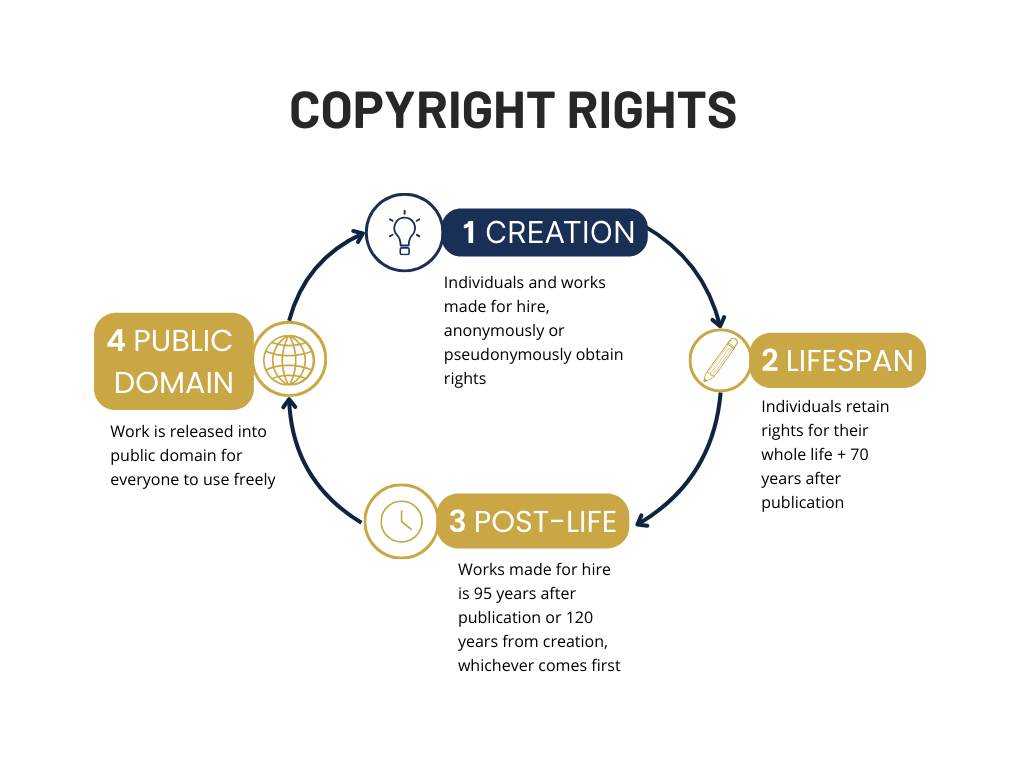
Copyright does not last forever. In the United States, the standard term is:
- Life of the author + 70 years for individual works
- 95 years from publication or 120 years from creation (whichever comes first) for works made for hire, anonymous, or pseudonymous works
After this period, the work enters the public domain, meaning anyone can use it freely.
WHY DOES COPYRIGHT MATTER TODAY?
Creating and copying content is easier than ever in today’s digital world. Copyright law is crucial because it:
- Helps reduce the risk of unauthorized copying or reposting
- Strengthen your business from costly disputes
- Earn recognition and income from your creations
- Provides a framework for resolving disputes when works are misused
For businesses and individuals alike, understanding copyright is key to protecting your own work and respecting the rights of others. Contact us at JDL to help with your copyright process.
COPYRIGHT FAQs
Do I need to register my copyright?
Copyright exists automatically when you create a work, but registering with the U.S. Copyright Office can provide significant advantages. Registration is typically required if you want to file a lawsuit for infringement, and it may allow you to claim statutory damages and attorney’s fees. Because the process has specific requirements and deadlines, consulting with an attorney can help ensure your registration is completed correctly and on time, which could strengthen your ability to enforce your rights.
When do I need to register my copyright?
For statutory protection, you must register your work with the U.S. Copyright Office within three months after publication. This timeline can help preserve the ability to seek certain remedies in case of infringement.
Can I copyright an idea?
No. Ideas, methods, or systems arenot protected. Only the expression of an idea in a fixed, tangible form (text, video, audio, etc.) may be protected.
What happens if someone infringes my copyright?
If someone uses your registered work without permission, you may have legal options. These can include sending an attorney-drafted cease and desist letter, filing a DMCA takedown request, seeking an injunction from a court, or pursuing monetary damages. Registration strengthens your case in the long run, such as statutory damages and attorney fees.
WHAT TO REMEMBER
Copyright law is a legal shield that protects creativity, business, and livelihood. Whether you are a writer, musician, entrepreneur, or someone who posts online content, copyright ensures your work belongs to you and gives you the right to decide how it is used.
By knowing what is protected, what is not, and how long protection lasts, you can take steps to secure your own rights and respect the rights of others. When questions arise, working with a qualified attorney can help support your copyrights are properly registered and enforceable.
The information provided in this blog, article, or video post is for general informational purposes only and is not intended to be legal advice. The matters discussed in this article may be complex and subject to varying interpretations and applications depending on the specific facts and circumstances, and changes in law. This post is not a substitute for professional legal advice tailored to your individual situation. No reader should act or refrain from acting on the basis of any information included in, or accessible through, this post without seeking the appropriate legal or other professional advice on the particular facts and circumstances at issue from a lawyer licensed in the recipient’s state, country, or other appropriate licensing jurisdiction. This blog post nor anything on this website shall create an attorney-client relationship.
This blog post is considered lawyer advertising. Prior results do not guarantee a similar outcome.